Choosing markets is easy. Competing well in them is not.

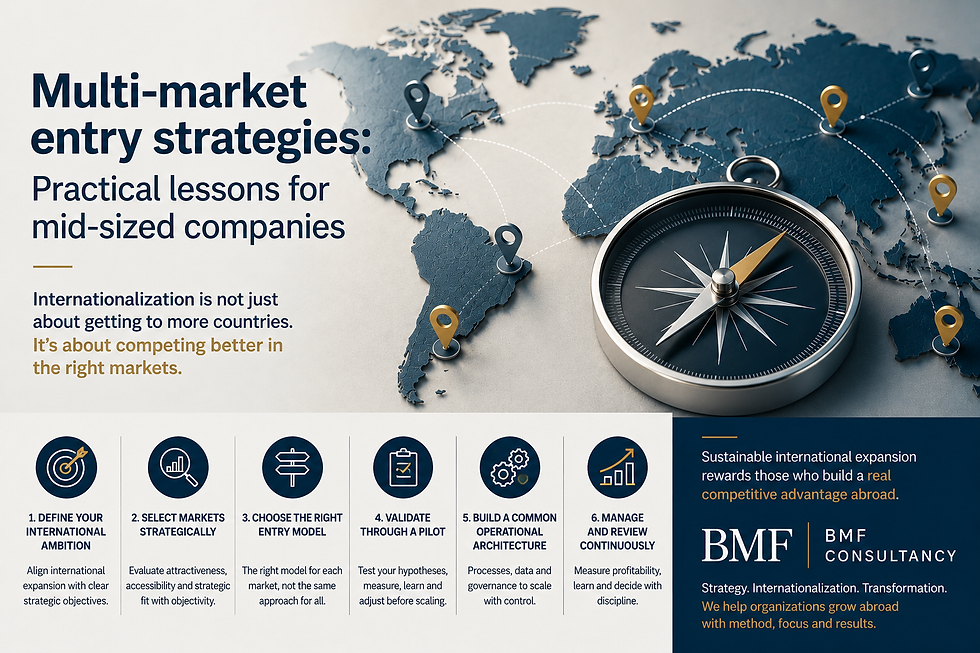
For a medium-sized company, internationalization is not about "going abroad." It's about deciding where to compete, with what operating model, with what level of investment, and with what real capacity for local adaptation .
The most common mistake isn't choosing the wrong country. It's trying to enter multiple markets with an overly generic approach, assuming that the product, brand, or channel will perform similarly in all of them.
Experience proves otherwise: a multi-market strategy demands focus, sequencing, and discipline. Entering several countries simultaneously can accelerate growth, but it can also fragment resources, strain the organization, and multiply commercial, regulatory, and operational risks.
1. Multimarket internationalization doesn't begin with the map
Many medium-sized companies approach international expansion from a seemingly logical question: "Which countries should we go to?"
But the prior question is another: what advantage can we transfer and in which markets does that advantage have differential value?
McKinsey puts it simply: global growth makes sense when a company can "outperform the local player," not just when the market seems attractive. A country's appeal—its size, growth, income, and stability—isn't enough if the value proposition doesn't surpass local alternatives.
For a medium-sized company, this requires evaluating three dimensions before selecting markets:
Transferable advantage. Which capabilities transfer well: technology, industrial know-how, brand, sector specialization, operational efficiency, technical service, design, value for money.
Cost of adaptation. Which parts of the model need to be modified: product, certifications, pricing, channel, logistics, customer service, after-sales support, local team.
Execution capacity. What the organization can absorb without losing control over the core business.
Internationalization should not be an accumulation of opportunities. It should be an architecture for growth.
2. Market appeal can be deceiving
Large markets usually appear at the top of any analysis. But for a mid-sized company, size isn't always the best entry criterion.
A market can be attractive and, at the same time, inaccessible. It may have demand, but require a costly commercial structure. It may have growth, but require slow certifications. It may offer profit margins, but depend on local relationships that are difficult to build.
The European Commission notes that global markets are a significant source of growth for SMEs, but also points out that only around 600,000 European SMEs export goods outside the EU, employing approximately 6 million people. The gap between potential and reality remains substantial.
Therefore, multi-market analysis must differentiate between:
Attractive markets , where there is potential demand.
Accessible markets , where the company can enter with reasonable resources.
The priority should be at the intersection of the three.
3. Entering multiple markets does not mean entering them all in the same way.
One of the most important decisions is choosing the right entry model for each market. Not all countries require a subsidiary, nor can all be managed through distributors. Not all justify acquisition, nor do all allow for a direct digital strategy. Market maturity, regulatory complexity, the need for local service, and the desired level of control should determine the model.
In practice, a medium-sized company usually works with a combination of approaches:
Direct export , when the product is relatively standard and the commercial complexity is low.
Local distributor or agent , when quick access to channel, contacts or local knowledge is needed.
Strategic partner , when the market demands credibility, complementary capabilities or institutional presence.
Commercial subsidiary , when the potential volume justifies direct control and brand building.
Joint venture or acquisition , when market access depends on local capabilities that are difficult to replicate.
PwC emphasizes that international expansion can take many forms—exporting, joint ventures, partnerships, acquisitions, or organic growth—and that each involves different risks and requirements regarding planning, taxation, people, and governance.
The practical lesson is clear: a multi-market strategy should not strive for uniformity, but rather coherence . Coherence in objectives, indicators, and governance; flexibility in the entry method.
4. Sequence matters as much as selection
Entering three markets in three years is not the same as entering three markets in three months. The sequence allows for learning, adjusting, and reusing capabilities. A medium-sized company cannot afford to treat each country as an isolated project. It must build a learning curve: what is validated in the first market should reduce uncertainty in the second; what is learned in the second should improve speed in the third.
A practical approach involves classifying markets into three groups:
Pilot market. It serves to validate international hypotheses with controlled risk. It doesn't always have to be the largest market, but rather the one that allows for the fastest learning.
Adjacent markets. They share regulatory, cultural, logistical, or commercial similarities. They allow for scaling up learning.
Strategic markets. They require more investment, more adaptation, and greater commitment. They should be addressed once the organization has already developed international strength.
This approach avoids a common trap: dedicating too many resources to the "dream market" before having developed the necessary capabilities to compete in it.
5. Local adaptation is not cosmetic.
In internationalization, adapting doesn't mean translating a website or changing a catalog. It means understanding how people buy, who makes the decisions, what objections arise, what level of service is expected, and what level of trust the company needs to build.
Harvard Business Review has highlighted the importance of relationships with local partners, cultural adaptation of the brand, integration with local norms, and the ability to learn from the environment when expanding into foreign markets.
For a medium-sized company, adaptation must be selective. Adapting everything destroys efficiency. Adapting nothing limits acceptance.
The useful question is not “should we adapt?”, but:
Which elements should be global and which elements should be local?
Global can be the value proposition, quality, technology, methodology, corporate brand, or operating standard.
Local can be the pricing, the channel, the commercial references, the messages, the complementary services, the partners or the contractual model.
BCG insists that growth in emerging markets requires localized strategies, especially in sales, distribution, and go-to-market models.
A medium-sized company that internationalizes successfully doesn't mechanically replicate its domestic model. It deconstructs it, decides what to preserve, and adapts what influences purchasing decisions.
6. The operating model is often the bottleneck
Many international strategies fail not due to a lack of demand, but due to a lack of an operating model.
Selling in another country involves answering very specific questions:
Who generates leads? Who qualifies opportunities? Who negotiates? Who invoices? Who delivers? Who provides support? Who manages incidents? Who measures profitability by country? Who decides whether to invest more or make corrections?
Deloitte argues that international expansion should be approached in a coordinated manner, incorporating fiscal, legal, and operational dimensions, among other critical considerations.
For medium-sized companies, this requires designing an international operating model before accelerating:
Governance. Who decides priorities, investments, prices, partners, and exceptions.
Processes. How sales, contracts, logistics, collections, support and reporting are managed.
Data. Which indicators are tracked by market and how often.
Talent. Which capabilities should be centralized, which localized, and which can be outsourced.
Technology. What tools allow you to operate without losing visibility or control?
Without this system, each market begins to operate with its own rules. And when that happens, management stops managing international expansion and starts managing a series of exceptions.
7. Partners accelerate, but they also create conditions
A local partner can be a decisive advantage: it brings knowledge, a sales network, legitimacy, access to customers, and speed. But it can also become a source of dependency.
The common mistake is choosing partners based on immediate sales opportunities, without evaluating their strategic fit. A good distributor isn't just someone with contacts. It's someone who understands the positioning, respects profit margins, shares market information, invests in business development, and enables the building of a presence in the medium term.
Before signing, it is advisable to consider:
Actual channel coverage. Not the declared coverage, but the demonstrable coverage.
Active sales capacity. Whether you sell consultatively or simply add the product to the catalog.
Strategic compatibility. Whether the product will be a priority or marginal.
Information transparency. Will you share customer data, pipeline information, pricing, and feedback?
Exit conditions. What happens if you don't meet objectives or if the company decides to change its model.
In complex markets, a partner can be the entry point. But the company must prevent it from becoming the market's owner.
8. International profitability must be measured more rigorously
One of the risks of multi-market expansion is confusing sales with progress. Invoicing in several countries can create a sense of advancement, but real profitability can be eroded by discounts, logistics costs, travel, product adaptation, technical support, returns, channel financing, or administrative complexity.
Therefore, each market must be evaluated with a sufficiently granular profit and loss statement.
Measuring revenue is not enough. You also need to measure:
Net margin per market. After commercial, logistical, regulatory and support costs.
Acquisition cost. Including management time and opportunity cost.
Conversion rate. From lead to closed and paid sale.
Channel quality. Volume, recurrence, margin, and customer control.
Learning level. Useful information obtained for other markets.
A small but profitable, repeatable market with low complexity can be more valuable than a large market that consumes resources without consolidating.
9. Internationalization requires an organization prepared to learn
International expansion is not just a business decision. It is an organizational transformation.
It requires professionalizing processes, documenting knowledge, strengthening reporting, developing middle management, improving financial planning, and making decisions with incomplete information.
The OECD has historically pointed out that SMEs encounter significant barriers in international markets, including lack of information, financing limitations, identification of opportunities, and trade obstacles.
In medium-sized companies, these barriers are not overcome solely through ambition. They are overcome through capabilities. Some are especially critical:
Market intelligence. Ability to prioritize with data, not just intuition.
Partner management. Selection, negotiation, monitoring and replacement if necessary.
International financial control. Visibility over margin, collection risk and investment needs.
Commercial adaptation. Messages, talking points and references tailored to the local context.
Internal governance. Clear decision-making rhythm between general management, sales, operations, finance and legal.
A structured internationalization builds capabilities within the organization. An improvised internationalization creates dependence on specific individuals.
10. A practical framework for medium-sized companies
A medium-sized company that wants to enter several markets should work with a six-step logic:
1. Define international ambition
It's not enough to say "we want to grow internationally." You have to specify what you're looking for: risk diversification, access to growth, improved margins, proximity to global customers, competitive advantage, or building an international brand.
Each objective leads to different markets and models.
2. Select markets using weighted criteria
The analysis should combine attractiveness, accessibility, strategic fit, competitive intensity, regulatory requirements, entry costs, and operational capacity.
The matrix must avoid two biases: choosing only large markets or choosing only nearby markets.
3. Design the market entry model
Export, distributor, partner, subsidiary, acquisition, or hybrid model. The decision should take into account the level of control required and the cost of building a presence.
4. Build a pilot with clear hypotheses
Before scaling, you need to validate: value proposition, pricing, channel, sales cycle, objections, service costs, and profitability.
An international pilot program is not an informal test. It is a strategic experiment with metrics.
5. Create a common operational architecture
Processes, reporting, CRM, contracts, partner governance, financial control, and internal responsibilities. Without this foundation, scaling increases complexity faster than revenue.
6. Review the market portfolio periodically
Not all markets deserve to continue. Some should be accelerated, others maintained, others redesigned, and others abandoned.
The discipline of exiting is as important as the decision to enter.
Conclusion: Internationalization is not about multiplying countries, it's about building competitive capacity.
For a medium-sized company, multi-market expansion can be a very relevant growth lever. But only when approached methodically.
Internationalization doesn't necessarily reward those who enter the most countries first. It rewards those who understand where they can compete, adapt as needed, protect their critical resources, and turn each market into a learning experience.
The challenge is not having an international presence. The challenge is building an organization capable of growing internationally without losing focus, margin, or control.
At BMF Consultancy we help organizations structure these types of processes: market selection, definition of the entry model, operational design, international governance and support in the internal transformation required to grow abroad.
The question that any medium-sized company should ask itself is not just: in which markets do we want to be?
The most demanding question is: what kind of organization do we need to be to compete well in them?


Comments